
 Social Psychologist & Personal Advisor
Salvation by Grace through Faith:
A Covenant Context

receive Salvation from sin, Eternal Life, and entrance into the Kingdom of Heaven,
which is a very Different Way compared to how most Protestant Religions teach,
based upon their interpretation of the preachings of Paul the Apostle.
Salvation & Eternal Life. Conclusions which come from direct teachings of the Bible.
2 - The Works That I Do Shall Ye Do Also: Making a Saving Covenant.
3 - The Written Law of Christ: By Faith We Access Saving Grace.
4 - Out-of-Context Controversies: Clarifying Conundrums.
The Covenant Context of Salvation:
God Saves Us Graciously as We Serve Him Faithfully
Faithfulness is Required to Gain Access to God's Saving Grace
* * * * *.
And to Jesus the mediator of the new covenant . . .
that great shepherd of the sheep, through the blood of the
everlasting covenant, make you perfect in every
good work to do his will, working in you
that which is wellpleasing . . .
through Jesus Christ.
(Hebrews 12:24; 13:21)
.* * * * *.
The importance of covenants in the Lord’s plan of life is reflected in the Bible’s two great divisions: The Old Testament and New Testament. The word “testament” derives from a Hebrew word meaning “covenant.” Thus the grand divisions of the Bible can also be characterized as the Old Covenant and the New Covenant.
The following is a comprehensive review of Bible teachings on Salvation that clarifies the meaning of Faith, Good Works, and Grace — within a Covenant Context.
Paul’s Preaching on Salvation. In explaining Salvation, some place great emphasis upon two passages by Paul:
“Not by works
of righteousness which we have
done, but according to his
mercy he saved us.”
(Titus 3:5)
“For by grace are
ye saved through faith;
and that not of yourselves:
it is the gift of God: Not of works,
lest any man should boast.”
(Eph. 2:8-9)
On the surface, these passages appear to drastically discount the role of good works within God’s plan of salvation. But these declarations by Paul paint only a partial picture of salvation, especially when juxtaposed to the teachings of Jesus. Deciphering Paul’s words without weighing a complete biblical context can result in the interpretive tail of a few verses wagging the doctrinal dog.
The Apostle Peter gave this specific caution:
“Our beloved brother Paul also according to the wisdom
given unto him hath written unto you; As also in
all his epistles, speaking in them of these
things; in which are some things
hard to be understood.”
(2 Peter 3:15-16)
Especially as the Apostle's teachings are interpreted within the broad context of all Bible passages, we can rely upon the words of Paul that pertain to a given doctrine. Thorough study of the scriptures on the topics of Grace, Good Works, and Faith reveal a context that clarifies Paul’s sometimes “hard to be understood” statements.
As context is considered, we see that God’s plan of salvation is solidly established within a covenant context—where both sides of saving commitments must be kept for the covenant to be complete. To disregard humanity’s participation in God’s legacy of covenant making is analogous to the “eye” saying "unto the hand, I have no need of thee.” Even though we are “more feeble” members of the covenant contract, still our contributions "are necessary" (1 Cor. 12:21-22) to complete of the whole.
Solving Paul’s Salvation Puzzle. For his birthday, my second son received a book of crossword puzzles. As he filled out one particular puzzle, he asked for help with a question that was hard for him to understand. The clue was “One of the senses,” and the answer fit into five spaces. “Because they do not have five letters, that eliminates the words hear and hearing,” we reasoned together, “and that leaves the words ‘sight,’ ‘taste,’ ‘touch,’ and ‘smell’ as possibilities for our puzzle.”
I told my son to solve the parts of the puzzle he could be sure of, first. By discovering the words that crossed with our five-letter word, the answer to this harder question would come clear. Soon we discovered that the word we were looking for had to begin with the letter “t,” thus eliminating “sight” and “smell.” The final solution became obvious by first finding answers that were sure and definite.
As we assemble a complete picture of salvation, using the puzzle pieces provided by the apostle Paul, let’s first look to Bible teachings that are completely clear and easy to understand. Then as we compare clearly understood passages against Paul’s harder-to-understand statements, certain interpretations will be eliminated—just as certain answers are excluded in the process of solving a crossword puzzle.
Sure & Definite Doctrines of Salvation
Believing in Christ. “For God so loved the world, that he gave his only begotten Son, that whosoever believeth in him should not perish, but have everlasting life” (John 3:16). Numerous Bible verses establish that those who believe in Christ will be saved. There is no doubt that salvation comes through this fundamental contingency: Believing in Christ.
Connected to the Vine by Covenant. The word contingency means that one possible event (Salvation) depends for its occurrence upon another event (Believing in Christ).
While man’s choice to believe in Christ opens up the possibility of salvation, it is only through the mercy and grace of our loving Lord that we can even exercise the choice to believe or not believe in the first place. Jesus declared:
“I am the Vine,
ye are the branches:
He that abideth in me, and I in him,
the same bringeth forth much fruit: for
without me ye can do nothing.”
(John 15:5)
Our Believing in Christ unto salvation is “fruit” that flourishes because the Vine provides life-giving nourishment. Therefore, “the grace of the Lord Jesus Christ” (Acts 15:11) is the ultimate Source that feeds the fruits of our salvation. We cannot bring forth that fruit by ourselves; and this is why Paul warned that no man “should boast,” thinking salvation has been earned through human efforts alone.
Rather, mankind must rely wholly upon the merits of the Messiah, who is mighty to save—“for there is none other name under heaven given among men, whereby we must be saved” (Acts 4:12). Nothing that human beings do by themselves, apart from God’s grace, will save them. Nevertheless, because salvation occurs within a covenant context, mankind’s covenant keeping is a necessary “work of faith”
(1 Thes. 1:3) that attaches us to the life-giving Vine. Great promises are given throughout the Bible to those who connect themselves to the Vine by making and keeping covenants:
“Now therefore, if ye will obey my voice indeed, and
keep my covenant, then ye shall be a peculiar treasure unto me
above all people: for all the earth is mine: And ye
shall be unto me a kingdom of priests,
and an holy nation.”
(Exodus 19:5-6)
This verse uses contingency language, which is indicative of covenant making: IF ye will obey my voice, THEN ye shall be a peculiar treasure, an holy nation. As we come to understand God’s long legacy of covenant making and covenant keeping, the interconnected roles of Faith, Good Works, and Grace come clear.
Doing Good. Believing in Christ means much more than just "generally" believing that He is good and that He loves us — Believing in Christ means that we believe what He says. As to salvation and eternal life, Jesus taught:
“Marvel not at this: for the hour is coming, in the which
all that are in the graves shall hear his voice, And
shall come forth; they that have done good,
unto the resurrection of life; and they
that have done evil, unto the
resurrection of damnation.”
(John 5:28-29)
Two different types of salvation are identified in this scripture; two ways the Savior saves us:
** We are saved from the physical death of the body, which is the first death. Through the atonement of Jesus Christ all mankind will be resurrected: "they that have done good, unto the resurrection of life; and they that have done evil, unto the resurrection of damnation" (John 5:29). As Paul puts it, “For as in Adam all die, ... in Christ shall all be made alive” (1 Cor. 15:22). This sense of salvation--when the body is raised from the grave and “made alive”--is given to all, even those who have “done evil” or have not believed in Christ.
** We are saved from what John the Revelator called the "second death" (Rev. 21:8)--meaning man’s separation, or damnation, from the presence of God. As the Apostle testified: “Jesus ... shall save his people from their sins” (Matt. 1:21), and thereby, save us from the “wages of sin” (Rom. 6:23). Paul declared, “the wages of sin is death.” Being saved from our sins and entering into God’s presence is the “resurrection of life” (John 5:29) of which Christ has spoken—which is also referred to as “eternal life” (John 3:15; 6:54) or simply as “life” (Matt. 19:17) in the Bible.
While salvation from the first death (physical) is a free gift — having absolutely no conditions attached — salvation from the second death (spiritual) is contingent upon at least two fundamental choices:
1) We must believe in Christ.
2) We must have “done good” in this life..
In solving our salvation puzzle, we can hold tight to these sure doctrines taught by Jesus — and there are more sure doctrines that will make our salvation puzzle complete. And with the addition of each new puzzle piece comes this clear conclusion: Salvation unto eternal life is a gift graciously given within the contingencies of a covenant context.
And as we fit together a complete picture of salvation, it is vital that we do not import contemporary interpretations upon ancient words; the Bible can clarify itself as to what Believing in Christ is, and what Doing Good might be!
What does it mean to Believe in Christ? Jesus directly defined what it meant to be a believer:
“He that believeth on me, the works that I do shall he do also” (John 14:12).
Believing in Christ means that we follow His example and do the good works that He did—yielding our "own will, [to] the will of the Father" (John 5:30). If grace were the only operating element in gaining salvation, why would Jesus exhort his followers to do “the works” (John 14:12) that He did?
By inviting us to do good works, Jesus gave believers their side of a saving covenant. Because the Bible consistently uses contingency language when speaking of salvation, it is clear that Christ expects His followers to faithfully keep covenants.
Speaking of those who are unfaithful, those who “obey not,” Peter taught:
“For the time is come
that judgment must begin at the house of God:
and if it first begin at us, what shall the end be of them that obey not
the gospel of God? And if the righteous scarcely be saved,
where shall the ungodly and the sinner appear?”
(1 Peter 4:17-18)
Peter makes the point that the “ungodly” should not have high hopes on “judgment” day, for if the “righteous scarcely be saved,” this means the “ungodly” flagrantly fall short. To be a "chosen vessel ... to bear" His name (Acts 9:15), believers must follow Him; to "follow his steps" (1 Pet. 2:21) IS “the patient continuance in well doing” of those who “seek ... eternal life” (Romans 2:7).
Jesus was asked, “What shall we do, that we might work the works of God?” (John 6:28). He answered, “This is the work of God, that ye believe on him whom he hath sent” (John 6:29).
Given the war of words that sometimes argues faith over works, and works over faith, it is vital to note that the Bible actually gives a circular definition of the two; the Bible defines believing in Christ as manifesting "the works" of Christ (John 14:12), and defines working "the works of God" as believing in Jesus "whom he hath sent" (John 6:28-29).
One Whole Reality: The Work of Faith. The debate of faith versus works is created by the weakness of words: Because these two word symbols are separate in written and spoken language, some erroneously assume that two separate things are represented by these two separate symbols. But there is no division in the reality that these words represent — that reality is whole and undivided. Faith and Good Works are two descriptive aspects of one unified reality: Working-Faithfully, or as the Apostle Paul taught, “the work of faith” (1 Thes. 1:3).
This is precisely why James taught that “faith without works is dead” (James 2:20), as did Christ who counseled:
“Not every one that saith unto me,
Lord, Lord, shall enter into the kingdom of heaven;
but he that doeth the will of my Father.”
(Matt. 7:21)
Both Jesus and James taught that a living faith is manifest by good works. The Savior also taught the reciprocal principle: that our works must be infused with good faith (Matt. 6:1-18) — thus dead works become . . . good works.
If our works are patterned after the ways of Jesus, such workings will always be done faithfully; this means good works are inseparable from having a “pure heart” (2 Timothy 2:22). In contrast, the Pharisees of New Testament times would sometimes do faithless works with a motive to be “seen of men” (Matt. 6:5) — such works are called “dead works” (Hebrews 9:14).
Good works and good faith function in seamless harmony; whereas, good faith and dead works are contradictory! Again, the words “faith” and “good works” represent two descriptive aspects of one whole way of being like our Exemplar, Jesus Christ. Therefore, believers in Christ will “work the works of God” (John 6:28), and those who do the "works of God," just as Jesus "worked the works" (John 9:4) will faithfully believe in Him. Faith in Christ and doing His Good Works are done in one unified heartfelt effort—with no "boasting" (Romans 3:27) nor "hypocrisy" (Matt. 23:28; Luke 12:1)
The 2nd article in this 4 part series answers the question: What Does Doing Good Look Like? And, of course, the answers are explicitly given in Bible descriptions.
* * * * * * *
The Greatest Prize
for Life's labors isn't
in material possessions
or impressive accomplishments,
but in the progress of personal character.
You labor for your own becoming, this is your richest reward.
Who You Become is your greatest possession,
make it your Masterpiece!
(Changing Your Stripes, 2nd Edition, page 274).
The book, "Changing Your Stripes" presents principles for getting out of
the ditch in which you've been dumped (the difficulties of which you are a victim),
and the ditch in which you've jumped (the difficulties for which you volunteer).
"Mastering a challenging situation
is ultimately a matter of
mastering yourself!"
- Matt Moody
"Changing Your Stripes," teaches you the principles that lead to lasting change,
making you a new kind of creature capable of communicating
with calm, even as storms of contention swirl.
If these ideas resonate and ring true,
then . . . this book is for you!

Sold Exclusively
through this website
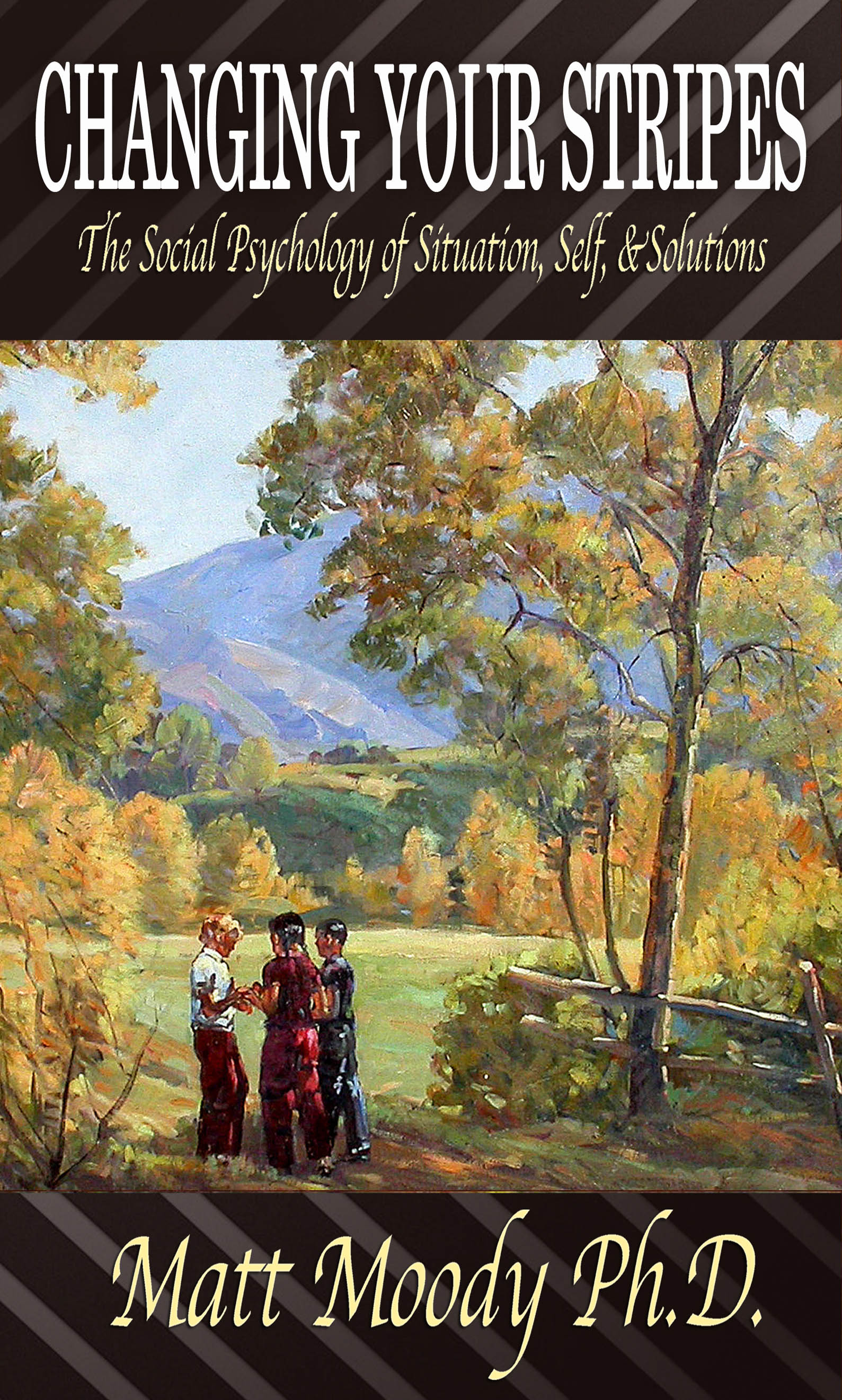
Changing Your Stripes is a
unique reference book that will help
you understand, . . . and solve all of
Life's ever-appearing problems
Here are more reasons to buy
Changing Your Stripes
Social Psychologist & Personal Advisor