Social Psychologist & Personal Advisor
How the Scriptures Disagree with
.John Calvin on Predestination.

as
John Calvin's Preachings About Predestination
.Contradict
what the Scriptures Teach.
by Matt Moody, Ph.D.
John Calvin's interpretation of Bible-based Predestination takes a sledge hammer to Human Free Will and smashes it to pieces:
"All are not created on equal terms, but some are preordained to eternal life, others to
eternal damnation; and, accordingly, as each has been created for one or other
of these ends, we say that he has been predestinated to life or to death."
"By predestination we mean the eternal decree of God, by which
He determined with Himself whatever He wished
to
happen with regard to every man."
~ John Calvin
Because the teachings of John Calvin completely dismiss the reality of Free Will for all humanity, Calvinism is very unpopular among most Christians; according to a Pew Research Poll only 1% of Christians in the United States believe the teachings of John Calvin, and 3% of Christians believe Calvinism globally.
This means about 2.3 million Christians in the USA believe the teachings of John Calvin, and approximately 70 million Christians world-wide believe in Calvinism. Thus, many millions of Christians believe in some form of predestination. It is common to hear the implied belief in predestination, when people say: "there are no accidents" or "it was meant to be" or "everything happens for a reason."
Here's the problem with believing John Calvin's teachings about predestination: Such Christians can become passive about pursuing their heavenly destiny. Why? Because Calvinism falsely preaches that our eternal destiny is completely predetermined by God.
The assumptions that "there are no accidents" and that "it was meant to be"—regardless of intentionally unwise choices—means that God predetermines even our foolishness. And the Bible directly admonishes against being foolish:
"The foolishness of man perverteth his way:
and his heart fretteth against the Lord."
(Proverbs 19:3)
"Better is a poor and a wise child than
an old and foolish king, who will
no more be admonished."
(Eccles. 4:13)
According to Calvinism, a Sovereign God has predestined certain souls for hell from the moment of their creation:
"Eternal life is foreordained for some, and
eternal damnation for others. Therefore, every
man, being created for one or the other of these ends,
is predestined either to life or to death."
~ John Calvin
The God of Calvinism has allegedly created a race of robots, who have no moral agency—no free will—instead, God predetermines the choices and actions of both the righteous and the wicked even before they are born into mortality. Hence, the God of Calvinism literally pre-determines all foolish thoughts and actions.
If Calvin's teachings were correct, this means the Almighty is the author of the Holocaust, and that the innocent young Jewish girl, Anne Frank, was predestined for Hell ... from her birth into a Jewish family.
This is where the Teachings of Calvinism go far astray from what the Bible actually teaches. Here's what God wants His followers to freely choose:
"And thou shalt love the Lord thy God with all thy heart,
and with all thy soul, and with all thy mind,
and with all thy strength."
(Mark 12:30)
"For the Lord your God proveth you,
to know whether ye love the Lord your God
with all your heart and with all your soul."
(Deut. 13:3)
Moral agency, a.k.a., free will, is absolutely required for God's process of proving, as the Almighty revealed to His prophet from the beginning:
"Then said the Lord unto Moses,
Behold, I will rain bread from heaven for you; ...
that I may prove them, whether they will walk in my law, or no."
(Exodus 16:4)
"Who led thee through that great and terrible wilderness, ... where
there was no water; who brought thee forth water out of the rock of flint;
Who fed thee in the wilderness with manna, ... that he might
humble thee, and that he might prove thee."
(Deut. 8:2, 15-16)
In order for God to "prove" His children, they must first be given moral agency to freely choose to "walk in my law, or no." And as Believers give their whole heart, soul, mind, and strength to loving the "Lord thy God," they can rely upon the promises of God to guide them and to help them during the test of proving:
But if thou shalt seek the Lord thy God, thou shalt find him,
if thou seek him with all thy heart and with all thy soul.
When thou art in tribulation, ... even in the latter
days, if thou turn to the Lord thy God, and
shalt be obedient unto his voice; ...
he will not forsake thee."
(Deut. 4:29-31)
Contrary to what Calvinism teaches, all mortals really do have the God-given responsibility and choice to qualify for entrance into God's Kingdom of Heaven; further, all mortals have the free-will choice to avoid the dire consequence of being "cast into hell fire" (Mark 9:47).
Those who have been touched by God's "love" (1 John 4:7-8) clearly know that He would never conceive of, nor create, a world where those who are condemned to hell are literally predestined to that fate—before they've even drawn mortal breath.
Thus, we should strive to live our lives in "the hands of the living God" (Heb. 10:31) but that Divine location of protection and guidance happens because we choose to put our lives in God's Hands—which means consistently being "obedient unto his voice" (Deut. 4:30).
So, one key reason for pushing aside the assumptions of Calvinism IS because John Calvin's fundamental teachings—especially about predestination—contradict Bible Truths. The scriptures directly teach that our Heavenly Father has created a world whereby His children must actively choose to live His Truths, and thereby reap His Promised Rewards.
.
FALSE TEACHING — Only Two Destinations of Judgment: Heaven or Hell
Within the beliefs of Calvinism there are only two Divine destinations of Final Judgment:
"God for His own glorification, ...
has created some as 'vessels of mercy,'
others as 'vessels of wrath.' Those created for
hell, He has
also predestined for sin. ...
all graces and means of salvation
are efficacious only in those
predestined for heaven."
~ John Calvin
On this topic of only Heaven or Hell, Dr Matt has written an article that presents a Bible-based case for more that one Heaven.
The Apostle Paul speaks of three heavens (2 Cor. 12:2), with each heaven shining with increasing whiteness and brightness: from the "glory of the stars," to the brighter shine of the "glory of the moon," to the brilliant brightness of the "glory of the Sun."
All of humanity will be blessed with "resurrection" (John 5:28-29). And during "the resurrection of the dead" there will be "celestial bodies, and bodies terrestrial ... one glory of the sun, ... another glory of the moon, and another glory of the stars" (1 Cor. 15:40-42).
Resurrected beings will inherit the heavenly glory that corresponds to their mortal history of doing as Jesus admonished: "Let your light so shine" (Matt. 5:16)—in addition to being true and faithful to the other requirements the Savior set forth in the four gospels.
Because God has planned for three kingdoms of glory, our very wise God has already prepared an eternal reward for those believers who "obey him" (Heb. 5:9), and He has also prepared an eternal reward for those who freely choose to live a life as "foolish ... virgins" (Matt. 25:2)—believers who do NOT diligently "obey him," and do NOT brightly shine the light of the Lord, nor choose to consistently do His will.
Here's that written article: Just Heaven or Hell is Not the True Bible Teaching.
The reason we absolutely know there is more than one heavenly Glory, is because of Bible teachings: First, being cast into Hell is NOT the destiny for Believers, even when they are "foolish." John the Revelator listed the sins that will result in a person having "their part in the lake which burneth with fire and brimstone" (Rev. 21:8).
The sin of "unbelieving" is one of the sins that results in hell fire, along with those souls who are "murderers, and whoremongers, and sorcerers, and idolaters, and all liars."
Realize that in the parable of the Ten Virgins, those who "were foolish" were still Virgins / Believers, even though there were not fully faithful to their beliefs. Thus, as "believers" they do not go to Hell; nevertheless, because they were also lacking in a full faith in Christ and love of God—"with all ... heart, and with all ... soul, and with all ... mind, and with all ... strength" (Mark 12:30)—neither do foolish believers inherit the Highest Heaven.
Different from the dreary, predetermined fate for which Calvinism contends, where God chooses the destiny of Hell for certain souls even before mortal birth, the truth about being "predestinated" (Eph. 1:5, 11) includes a mortal life where all members of humanity are indeed free to choose the ways of God—free to choose whether to obey His requirements to receive entrance into His Highest Heaven, or not.
.
Teachings of John Calvin Summarized by the Acronym: TULIP
Total Depravity
Because of the fall of Adam and Eve, every person is enslaved to sin; thus, mortal beings are by nature NOT inclined to love God, but rather to serve their own interests; this means, all people by their own faculties are morally incapable of choosing to obey God and be saved.
Unconditional Election
God has chosen those whom He will save, not based upon the virtue, merit, or the expressed faith of believers; rather, His choice is unconditionally grounded in His Grace and Mercy alone. God has chosen to extend saving grace to the Elect whom He has chosen.
Limited Atonement
Only the sins of the elect were atoned for by the death of Jesus Christ. But the atonement is not limited in its value or power; rather, the atonement is limited in the sense that it is intended only for some people, the elect, and not for all people.
Irresistible Grace
The saving grace of God is given only to those whom He has pre-determined to save, and He calls them "the elect." Thus, God overcomes a believer's natural resistance to obeying His call, and when God purposes to save someone, that individual will be saved.
Perseverance and Preservation of the Saints
The "Saints" are those whom God has predestined to save. Since God is Sovereign, His will cannot be frustrated; therefore, those who are destined to continue in faith until the end will be divinely chastened (Hebrews 12:5-11) and will ultimately repent (1 John 3:6-9). And those who fall away were never the Elect to begin with (1 John 2:19).
.
Quotes by John Calvin that establish TULIP versus a Scripture Rebuttal
Total Depravity
"Man's will is so utterly vitiated and corrupted in every part
as to produce nothing but evil."
"Their whole nature is, as it were, a seed-bed of sin,
and therefore cannot but be odious
and abominable to God."
"If we can no more bear fruit of ourselves
than a vine can bud when rooted up and deprived of moisture,
there is no longer any room to ask what the aptitude of our nature is for good."
"We shall never be clothed with the righteousness of Christ
except that we first know assuredly that we
have
no righteousness of our own."
~ John Calvin
Scripture Rebuttal:
"Behold, children are an heritage from the Lord,
and the fruit of the womb is a reward."
(Psalm 127:3)
"That the tradition might be done away, which saith that little children are
unholy; for it was had among the Jews; But little children are holy,
being sanctified through the atonement of Jesus Christ."
(Doctrine & Covenants 74:6-7)
"Every spirit of man was innocent in the beginning;
and God having redeemed man from the fall,
men became again, in their infant state,
innocent before God."
(Doctrine & Covenants 93:38)
.
Unconditional Election
"God preordained, for his own glory and the
display of His attributes of mercy and justice, a part of the
human race, without any merit of their own, to eternal salvation,
and another part, in just punishment of their sin, to eternal damnation."
"Many... admit the doctrine of election,
but deny that any one is reprobated...
This they do ignorantly and childishly, since there could be no
election without its opposite reprobation."
"Without reprobation, election
itself cannot stand."
~ John Calvin
Scripture Rebuttal:
"If ye keep my commandments, [then] ye shall abide in my love; even
as I have kept my Father's commandments,
and abide in his love."
(John 15:10)
"If a man love me, [then] he will keep my words:
and my Father will love him."
(John 14:23)
"I love them that love me; and those that
seek me ... shall find me."
(Proverbs 8:17)
"He that hath my commandments, and keepeth them, he it is that loveth
me: and he that loveth me shall be loved of my Father, and
I will love him, and will manifest myself to him."
(John 14:21)
.
Limited Atonement
John Calvin often argued that while Christ's death is sufficient for all, it is intentionally efficient only for the elect, thus defining a "limited atonement." A clear quote to this fact is found in Calvin's explanation of John 13:18, a commentary which states:
"Whence it comes about that the whole world does not belong to its Creator
except that grace rescues from God's curse and wrath and eternal death
a limited number who would otherwise perish. But the world itself
is left
to its own destruction, to which it has been destined."
The false teaching of Limited Atonement is found in Calvin's response to Tileman Heshusius—a Lutheran theologian and Protestant reformer—regarding the Lord's Supper:
"I should like to know how the wicked can eat the flesh
of Christ which was not crucified for them, and
how they can drink the blood which was
not shed to expiate their sins."
~ John Calvin
Scripture Rebuttal:
"The Lord is not slack concerning his promise, ... but is
longsuffering to us-ward, not willing that any should perish,
but that ALL SHOULD COME [emphasis added] to repentance."
(2 Peter 3:9)
"God is no respecter of persons: But in every nation he that feareth him,
and worketh righteousness, is accepted with him."
(Acts 10:34-35)
"If you keep not my commandments, [then] the love
of the Father shall not continue with you."
(Doctrine & Covenants 95:12)
"And [the Lord] loveth those who will
have Him to be their God."
(1 Nephi 17:40)
.
Irresistible Grace
"This grace, therefore, which is hiddenly bestowed in human hearts by
the Divine gift, is rejected by no hard heart, because it is given
for the sake of first taking away the hardness of the heart."
"Those of mankind that are predestinated unto life,
before the foundation of the world was laid...
God, out of His mere grace and love,
without any foresight of faith
or good works... hath
chosen in Christ."
~ John Calvin
Scripture Rebuttal:
"Therefore being justified by faith,
we have peace with God through our Lord Jesus Christ:
By whom also we have access by faith into this grace wherein we
stand, and rejoice in hope of the glory of God."
(Romans 5:1-2)
"There hath no temptation taken you
but such as is common to man: but God is faithful,
who will not suffer you to be tempted
above that ye are able;
but will with the temptation also make a way to escape,
that ye may be able to bear it."
(1 Cor. 10:13)
.
Perseverance and Preservation of the Saints
"Those who do not persevere unto the end
belong not to the calling of God.”
"In the elect alone he implants the living root of faith,
so that they persevere even to the end."
"Seeing that a Pilot steers the ship in which we sail,
who will never allow us to perish even in the midst of shipwrecks,
there is no reason why our minds should be overwhelmed
with fear and overcome with weariness."
"Even well-disposed persons have been subject to so many
distractions that they readily vanish or fall away
unless they are strengthened to persevere"
~ John Calvin
Scripture Rebuttal:
"For behold, I, God, have suffered these things for all, that they might not suffer
if they would repent; But if they would not repent they must suffer even as I;
Which suffering caused myself, even God, the greatest of all, to tremble
because of pain, and to bleed at
every pore, and to suffer both body
and spirit ... Nevertheless, glory be to the Father, and I partook
and finished my preparations unto the children of men."
(Doctrine & Covenants 19:16-19)
The Bible specifically speaks of the possibility of falling away (Heb. 6:4-6) from the Path of God. And falling away is ONLY possible among people who possess Free Will to Choose the Path of God, or not—to be "steadfast unto the end" (Heb. 3:12-14), or not.
"Wherefore let him that thinketh he standeth take heed lest he fall...
but
God is faithful, who will not suffer you to be tempted above
that ye are able... but will with the temptation also make
a way to escape, that ye may be able to bear it."
(1 Cor. 10:12-13)
John Calvin's teachings tend to overemphasize one Central Belief that "God is Sovereign"—which means: God rules with absolute control over all creation. And this Central Teaching of Calvinism is overemphasized to the point of diminishing all human responsibility: that Believers are not capable of responding faithfully to the Call of the Almighty. Nevertheless, the scriptures say otherwise:
"I call heaven and earth to record this day against you, that I
have set before you life and death, blessing and cursing: therefore
choose life, that both thou and thy seed may live: That thou mayest
love the Lord thy God, and that thou mayest obey his voice,
and that thou mayest cleave unto him: for he
is thy life, and the length of thy days."
(Deut. 30:19-20)
Why is God imploring His children to "choose," "love," "obey," and "cleave" ... if we are incapable of responding faithfully, due to Calvinism's assumed Total Depravity?
Remember that "God is faithful" and has promised to "make a way to escape" from every temptation "common to man" (1 Cor. 10:13). And it is up to you and I to CHOOSE the Divinely-provided "way to escape."
God would not offer to "make a way to escape," if "escape" were impossible to access.
.
Scriptures that Explain Free Will and God's Foreknowledge
Here's a Bible passage that directly contradicts the Calvinistic assumption that human beings do not have free will to choose between good and evil:
"See, I have set before thee
life and good, and
death and evil;
In that I command thee this day
to love the Lord thy God, to walk in his ways,
and to keep his commandments."
(Deut. 30:15-16).
It makes no sense, that God would fill the Bible with commandments that human beings have no free will to obey. In the Old Testament, the term "freewill offering" is mentioned 16 times, and when we look up the original word from which "freewill" is translated, we find the Hebrew noun: Nadab, which means = voluntariness.
Hence a freewill offering, is a voluntary offering. Reinforcing the reality of voluntary free will, the word of God as revealed to Moses explains:
"And if ye offer a sacrifice of peace offerings unto the Lord,
ye shall offer it at your own will."
(Leviticus 19:5)
"Ye shall offer at your own will a male without blemish, ...
And when ye will offer a sacrifice of thanksgiving
unto the Lord, offer it at your own will."
(Leviticus 22:20, 29)
Clearly, an offering cannot be voluntary or "at your own will" if it's predestined in the way John Calvin defines that word.
Some earthly events happen because God sets them up to happen at certain times and in certain ways. But God has wisely chosen to do what He does, within the context of a world inhabited by mortals with God-given free will, as the Apostle John testifies:
"And the Spirit and the bride say ...
Come. And let him that is athirst come. And
whosoever will, let him take the water of life freely."
(Rev. 22:17).
Jesus dedicated His life to teaching the good news of His gospel, so that His followers would come to "know the truth and the truth shall make [them] free" (John 8:32).
If Calvinism were correct, then all the Savior's imploring, persuading, and admonishing would be in vein, if God's children did not have the freedom to choose to embrace the admonitions of Christ and His prophets.
.
If Humanity Has Free Will, then How Does Predestination Happen?
Even amid a world full of Free-Will Choosers, God can still bring to pass the marvelous events prophesied in scripture; events that are predestined to occur decades and centuries before they happen.
One way God does this is through sweet invitations and gentle persuasions to His faithful children. For example, before Jesus was born an Angel of God appeared to Mary:
"And in the sixth month the angel Gabriel
was sent from God unto a city of Galilee, named Nazareth,
To a virgin espoused to a man whose name was Joseph, ... and the
virgin's name was Mary. And the angel came in unto her, and said,
Hail, thou that art highly favoured, the Lord is with thee:
Fear not, Mary: for thou shalt conceive in thy womb,
and bring forth a son,
and shalt call his name Jesus.
He shall be great, and shall be called
the Son of the Highest."
(Luke 1:26-32).
God the Father knows the hearts of His faithful children; thus, He can bring forth His purposes because He knows the faithful will obey vital invitations from the Holy Spirit, that are crucial to God's Will being manifest at certain times and in certain places.
Thus, the Predestination of the Birth of Jesus happened as prophesied, and still, all of Humanity retained Free Will to choose what they felt inclined to do—whether good or evil, as set forth from the beginning:
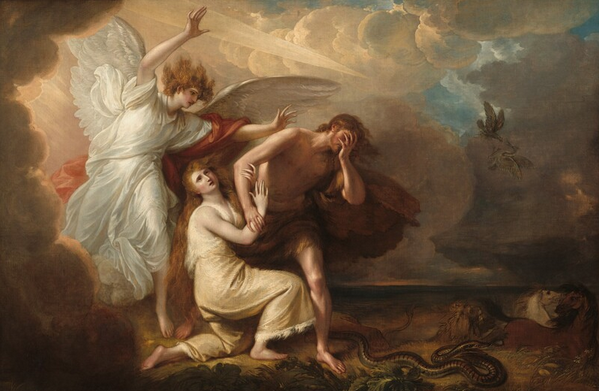
"And the Lord God took the man, and put him into the garden of Eden ...
And the Lord God commanded the man, saying, Of every tree of the garden
thou mayest freely eat: But of the tree of the knowledge of good and evil, thou
shalt not eat... for in the day that thou eatest thereof thou shalt surely die.
"And the Lord God said, Behold, the man is become as one of us,
to know good and evil: ... Therefore the Lord God
sent him forth from the garden of Eden."
(Genesis 2:15-17; 3:22-23)
The Old Testament further confirms the reality of Free Will by the words of Daniel:
"So the king of the north
shall ... cast up a mount, and
take the most fenced cities ...
But he that cometh against him
shall do according to his own will,
and none shall stand before [the king]"
(Daniel 11:15-16).
Because God the Father knows the tendencies of all His children through thousands of years of pre-mortal life, He has foreknowlege as to which of His children will choose to Obey Him and Do Good, when prompted by the Holy Spirit.
And conversely, God knows who will yield to the temptations of "Satan" (Rev. 12:7-9)—just as the Lord knew that Peter would "deny [Him] thrice" (Matt. 26:34).
The Apostle John described Jesus as "knowing all things that should come" (John 18:4); both God the Father and His Son, Jesus Christ, have foreknowledge of events that They personally set-up to happen, through the invitations of the Holy Spirit and by visitations of Angels, to faithful saints who will obey His words.
Thus, predestination in the Bible can be explained by the foreknowledge that the Father and the Son have concerning the behavioral tendencies of the faithful and the faithless. Divine foreknowledge can be thought of according to this analogy:
If a cookie is left in a room where a child who loves cookies is playing, it is very easy for anyone to foreknow that the child will eventually ... eat the cookie—when that cookie is left in an openly available and tempting location. And that foreknowing becomes even more sure as parents, siblings, or friends have years of experience observing the behavioral patterns of others—to include the behavior of young children.
So, even though we may KNOW that a child will eventually eat a cookie, our foreknowlege of this reality does not remove Free Will from children to eat a tempting cookie, or not.
While a loving and wise God does indeed strive to guide our paths through sweet invitations and gentle persuasions, nevertheless, Almighty God does NOT override our moral agency and determine our choices.
This means, the directions we may walk, and the way in which we choose to walk, are NOT preset or predestined according to God's Will—instead, personal decisions and directions are chosen, according to the free will of God's children.
.
Bible Verses upon which John Calvin based his False Assumptions
According to Calvin a predetermined judgment is already set by God,
"We call predestination God's eternal decree, by
which He compacted with Himself what
He willed to become of each man."
Calvin's incorrect conclusions come from his misinterpretation of the words "predestinate" (Rom. 8:29-30) and "predestinated" (Eph. 1:5, 11) found in four Bible verses, all written by the Apostle Paul. John Calvin also used the word "election" (Rom. 9:18-24) from the writings of Paul, to justify his incorrect TULIP conclusions.
Here's a Bible principle that applies, taught by two witnesses: Paul and Jesus.
"In the mouth of
two or three witnesses
shall every word be established.
(2 Cor. 13:1; Matt. 18:16)
John Calvin's interpretation of the Apostle Paul's word, "predestinate," does not have a 2nd or 3th witness to establish God's particular meaning for that word; instead, the teachings of other Bible witnesses contradict John Calvin's characterization of the word "predestinate"—again, a word which ONLY the Apostle Paul used, and no other Bible witness.
John Calvin's assumptions about the word "predestinate" nullifies Bible teaching about God's final judgment! The very word "judgment" (Matt. 23:23) as defined by the Bible Dictionary is "the spiritual parallel to being legally judged in a court of law against a preset standard."
Hence Judgment is God's "assessment" of every person's chosen thoughts, words, and deeds as compared against Bible Commandments—for which all humanity must be accountable:
"A good man out of the good treasure of the heart bringeth forth good
things: and an evil man out of the evil treasure bringeth forth evil
things. But I say unto you, That every idle word that men
shall speak, they shall give account in the day
of judgment. For by thy words thou shalt
be justified, and by thy words
thou shalt be condemned."
(Matt. 12:35-37)
The Bible teaches that you and I will "give account in the day of judgment" for "every idle word" that we speak, as well as every thought we think and every action that we choose to do. And this final accounting is ONLY real and meaningful, as you and I have freely chosen every thought, word, and deed.
But if John Calvin's beliefs were correct, then all that we think, say, and do is predetermined and "predestinated" by the Will of Almighty God; which means, there is no practical need to "give account" in the day of judgment—because, according to John Calvin, all that is done on earth is ultimately "willed" by God:
"We call predestination God's eternal decree, by
which He compacted with Himself what
He willed to become of each man...
out of His mere grace and love,
without any foresight of
faith or good works."
~ John Calvin
Thus, the essential meaning of the word "judgment" in the Bible is nullified by the false assumptions of Calvinism. The teachings of John Calvin are largely established by the misinterpretations of two words: Predestinate and Election. And no other Bible authors have used the word "predestinate." As for the word "election," Peter also used this word, but notice HOW the Chief Apostle speaks of Election as conditional:
"According as his divine power hath given unto us all things that pertain
unto life and godliness, through the knowledge of him that hath
called us to glory and virtue: Whereby are given unto
us exceeding great and precious promises:
that by these ye might be partakers
of the divine nature, ...
"giving all diligence, add to your faith virtue; and to virtue knowledge;
And to knowledge temperance; and to temperance patience; and
and to patience godliness; And to godliness brotherly kindness;
and to brotherly kindness charity.
For if these things be in you, and abound, ...
ye shall neither be barren nor unfruitful in
the knowledge of our Lord Jesus Christ.
"brethren, give diligence to make your calling and election sure:
for if ye do these things, ye shall never fall: For so an
entrance shall be ministered unto you abundantly
into the everlasting kingdom of our Lord
and Saviour Jesus Christ."
(2 Peter 1:3-4, 5-8, 10-11)
John Calvin's sole chance to get a 2nd witness pertaining to the meaning of the word "election," was with the only other Bible author who used that word, the Apostle Peter. And Peter did NOT confirm and "establish" (Matt. 18:16) Paul's apparent way of describing "election." Instead, the Chief Apostle made clear that according to our free-will choices:
"ye might be partakers of the divine nature,
For if these things be in you [and]
if ye do these things,
ye shall never fall"
(2 Peter 1:4, 8, 10).
Just as Jesus did over a dozen times in His mortal preachings, the Apostle Peter also guaranteed "precious promises" on the condition "if ye do these things."
And the following linked-webpage cites the quoted words of Christ wherein He set forth sixteen conditions within which Believers "might be" Saved from Sin, Inherit Eternal Life, and Enter into the Kingdom of Heaven ... if, and only if, Believers have "done good" (John 5:28-29), obeyed "the will of my Father" (Matt. 7:21), and "shall endure unto the end" (Mark 13:13)—to name just three of the sixteen conditions.
.
That His Judgments Might Be Just: Bible-based Free Will Revisited
While the Gospel Path we follow is indeed established by God, and was declared by the Son of God, nevertheless, whether we walk that Path and how we walk that path is determined by the free-will choices of God's children.
All of humanity have been given the Freedom to Choose the Lord's Gospel Path, and that freedom of choice is spoken of throughout the Bible:
"Now listen! Today I am giving you a choice
between life and death, between prosperity and disaster.
For I command you this day to love the LORD your God and
to keep his commands and decrees by walking in his
ways. If you do this, you will live and multiply,
and the LORD your God will bless
you."
(Deut. 30:15-16 NLT).
Also in the writings of Moses, God's desire to "prove" His children is established:
"And thou shalt remember
all the way which the Lord thy God
led thee these forty years in the wilderness,
to humble thee, and to prove thee,
to know what was in thine heart,
whether thou wouldest keep
his commandments, or no."
(Deut. 8:2, 16)
Clearly when God "proves" His children, such proving can only happen if the children of God have Free Will to "keep his commandments, or no." The prophet Joshua declared his ability to freely choose in this familiar and famous verse:
"Choose you this day
whom ye will will serve ... but as
for me and my house, we
will serve the Lord"
(Joshua 24:15)
.
Grace is given on Condition of our Faithfulness and Obedience to God
The free choice to express Faith in Jesus Christ IS how we "access ... grace"—a truth that the Apostle Paul taught the saints in Rome:
"Being justified by faith,
we have peace with God
through our Lord Jesus Christ:
By whom also we have access
by faith into this grace
wherein we stand"
(Rom. 5:1-2).
The Apostle Paul also preached this truth to the Ephesians:
"For by grace are ye saved through faith"
(Eph. 2:8).
Clearly a Faith that "is dead" (James 2:17, 20, 26) cannot "access" saving Grace! Which is precisely why Jesus taught His followers to "shine" the Light of Truth and Glorify God the Father by doing Good Works:
"Let your light so shine before men,
that they may see your good works,
and glorify your Father which is in heaven."
(Matt. 5:16)
Here are some of the "good works" the Savior taught His followers to do, that they might be Saved from Sin, Inherit Eternal Life, and Enter the Kingdom of Heaven:
1) "And ye shall be hated of all men for my name's sake: but he that endureth to the end shall be saved" (Matt. 10:22).
2) "He that believeth and is baptized shall be saved" (Mark 16:16).
3) "Good Master, what good thing shall I do, that I may have eternal life? ... Jesus said unto him, ... come and follow me" (Matt. 19:16, 21).
4) "Not every one that saith unto me, Lord, Lord, shall enter into the kingdom of heaven; but he that doeth the will of my Father which is in heaven" (Matt. 7:21).
5) "Come, ye blessed of my Father, inherit the kingdom prepared for you from the foundation of the world: For I was an hungred, and ye gave me meat: I was thirsty, and ye gave me drink: ... Then shall the righteous answer him, saying, Lord, when saw we thee an hungred, and fed thee? or thirsty, and gave thee drink? ... And the King shall answer and say unto them, Verily I say unto you, Inasmuch as ye have done it unto one of the least of these my brethren, ye have done it unto me" (Matt. 25:34-40).
"Lord, when saw we thee an hungred, or athirst, or a stranger, or naked, or sick, or in prison, and did not minister unto thee? Then shall he answer ... Inasmuch as ye did it not to one of the least of these, ye did it not to me. And these shall go away into everlasting punishment: but the righteous into life eternal" (Matt. 25:42-46).
That's five teachings of Jesus, among others, that contradict the false interpretation that Faithful Human Acts play no role in manifesting a believer's Faith in Jesus Christ, and thereby, contribute to receiving the Heavenly Blessings of Salvation, Eternal Life, and Entrance in God's Kingdom of Heaven. Again, it is active Faith by which Believers gain "access" (Rom. 5:1-2) to Saving Grace!
What is the meaning of the word "Grace"?
In the New Testament, the English word "Grace" is translated from the Greek word Charis (pronounced: khar'-ece), and Charis means: Loving Kindness. And in the Old Testament, the English word "Grace" is translated from the Hebrew word Chen (pronounced khane), and Chen means: Favor.
Therefore, the English word "Grace" from its Greek and Hebrew origins means:
God's Favor and Loving Kindness.
.
The False Interpretation that Saving Grace means Unmerited Favor
Exactly who is most in charge of the words and meanings in the Gospel of Jesus Christ? Would it be the Apostle Paul? Or would it be the Son of God, the Lord Jesus Christ?
In His Parable of the Sheep and the Goats, Christ taught that
the "righteous" shall go "into eternal life." Since the Son of God said it, we should simply believe it, because Jesus is the Divine Person through which His Gospel is primarily established.
Within the context of the Sheep and Goats parable, the "righteous" are those who show charity to "the least of these" by feeding the hungry, clothing the naked, and visiting the sick or in prison—these are "good works" that glorify God and are works that manifest Faith in the Lord, Jesus Christ, according to the teachings of the Apostle James.
The assumption that Saving Grace means Unmerited Favor comes from a "private interpretation" (2 Peter 1:19-21) of a single Bible verse: Ephesians 2:8. And this single verse does not have "two or three witnesses" (2 Cor. 13:1; Matt. 18:16) to confirm the false conclusion that: Salvation by Grace through Faith is granted by Unmerited Favor.
Here are the words that imply that Grace means Unmerited Favor:
"For by grace are ye saved through faith; and that
not of yourselves: it is the gift of God"
(Ephesians 2:8)
Jesus clarified why His Favor and Loving Kindness (a.k.a., Grace) is a gift. The Savior said:
"I am the true vine ... Abide in me, and I in you.
As the branch cannot bear fruit of itself, except it abide in the vine;
I am the vine, ye are the branches: He that abideth in me,
and I in him, the same bringeth forth much fruit:
for without me ye can do nothing."
(John 15:1-5)
Thus, it is through Christ's Favor and Loving Kindness that we are fruitful, for without His generous gift of Grace, we "can do nothing."
The Gift of His Grace includes the bestowing of Salvation, Eternal Life, and Entrance into the Kingdom of Heaven—all these fruitful blessings are given to Faithful Believers as they choose to consistently Abide in the True Vine.
In Ephesians 2:8, it is unclear exactly what the Apostle is referring to as God's gift?
Is "the gift of God" of which Paul speaks: that of being "saved," or is "the gift" referring to God's "grace"? Or was the Apostle speaking of the "faith" by which we access saving grace, as "the gift of God" ?
Every blessing tied to our eternal salvation originates from the choice to Abide in the True Vine. And as Paul taught, Faith in the Lord, Jesus Christ is our "access" (Rom. 5:1-2) to God's Saving Grace—with Faith in our Savior being most fundamentally manifest by the free-will decision to Abide in the True Vine.
To be in harmony with the teachings of Christ, the Apostle Paul endeavored to be a witness for the following truths:
By God's Favor and Loving Kindness we are saved through faith, for without
sustaining nurture of the True Vine we can do nothing of our selves,
Thus fruitfulness is given as a gift from the True Vine. And
fruitfulness unto eternal salvation is accessed
only through the
free-will choice to
Abide in the True Vine.
.
Accessing Saving Grace through Faith in Jesus Christ
While you and I do not merit or earn the Grace of God, still, we "access" (Rom. 5:1-2) Saving Grace only through Faith in the Lord, Jesus Christ.
As established by what Christ declared and by what His Apostle James taught, Faith in Jesus Christ is not passive; instead, Faith in Jesus Christ is actively manifest by Obeying the Words of Christ and Faithfully Following His Example.
Jesus confirmed that Belief and Faith in Him, are inseparable from Faithfully Following Him. The Savior said:
"Most assuredly, I say to you, he who believes in Me,
the works that I do will he do also" (John 14:12 NKJV).
"For everyone practicing evil hates the light and does not come to the light,
lest his deeds should be exposed. But he who DOES THE TRUTH [emphasis added]
comes to the light, that his deeds may be clearly seen, that they have
been DONE IN GOD [emphasis added]" (John 3:20-21 NKJV).
On the theme of Faith and Love manifest by Human Acts, the Son of God adds this witness:
"Marvel not at this: for the hour is coming,
in the which all that are in the graves shall hear his voice,
And shall come forth; they that have DONE GOOD [emphasis added],
unto the resurrection of life; and they that have done evil,
unto the resurrection of damnation" (John 5:28-29).
What Christ calls "done good," is accomplished through obedience to Christ's new Law of Faith; obedience that is necessary to bringing forth the good fruit ... "of eternal salvation"—a 2nd witness to this Truth is given by the Apostle Paul:
"Though he were a Son, yet learned He obedience
by the things which He suffered; And being made perfect,
He became the author of eternal salvation unto all
them that obey Him" (Hebrews 5:8-9).
Jesus taught:
"He that believeth on the Son hath everlasting life: and
he that believeth not the Son shall not see life;
but the wrath of God abideth on him"
(John 3:36).
* * * * *
"For by grace are ye saved THROUGH FAITH [emphasis added];
and that not of yourselves: it is the gift of God"
(Eph. 2:8).

Again, we "access" God's Saving Grace through faith in our Lord and Savior. And "abiding in the true vine" is the foundational way we manifest faith in Jesus Christ.
Notice how the alleged "Free Ticket to Heaven" is simply given by Grace alone, with no mention of the words "through faith." This is just one among many misinterpretations originating from the Most Misinterpreted Verse in the Bible: Ephesians 2:8-9.
The words "through faith" affirm what Jesus taught:
"For God so loved the world, that he gave his only begotten Son, that whosoever believeth in him should not perish, but have everlasting life."
(John 3:16)
Believing in Jesus, having Faith in Him, means that we must "follow his steps" (1 Pet. 2:21). For, if there is no "Following" there is no Faith!
We must have an active and living Faith in Jesus Christ to be saved by God's Grace. As the Apostle James taught: "faith, if it hath not works is dead, being alone" (James 2:15-17)—and "dead" faith has absolutely no access to Saving Grace.
Related Articles:
The Most Misinterpreted Verses in the Bible: Ephesians 2:8-9
Just Heaven or Hell are not the Only Options in God's Final Judgment
Solving Bible Conundrums created by Misinterpreting the Epistles of Paul
The Journey
For this is the Journey that mortals make:
To find themselves. If they fail in this, it matters little
whatever else they may achieve: Money, Fame, Revenge, Pleasure.
When they end the Journey, they can put them all into
a bin marked "ashes." They mean nothing.
But if one has found that she has within her
a divine soul, if she has discovered the principles
upon which the fulfillment of that soul is based, and
if she implements those principles, then she has a mansion
within which she can live with dignity
and joy each day of her life.
* * * * * * *
The Greatest Prize
for Life's labors isn't
in material possessions
or impressive accomplishments,
but in the progress of personal character.
You labor for your own becoming, this is your richest reward.
Who You Become is your greatest possession,
make it your Masterpiece!
(Changing Your Stripes, 2nd Edition, page 274)
The book, "Changing Your Stripes" presents principles for getting out of
the ditch in which you've been dumped (the difficulties of which you are a victim), and
the ditch in which you've jumped (the difficulties for which you volunteer).
"Mastering a challenging situation
is ultimately a matter of
mastering yourself!"
- Matt Moody
"Changing Your Stripes," teaches you the principles that lead to lasting change,
making you a new kind of creature capable of communicating
with calm, even as storms of contention swirl.
If these principles resonate and ring true,
then . . . this book is for you!

Sold Exclusively
through this website
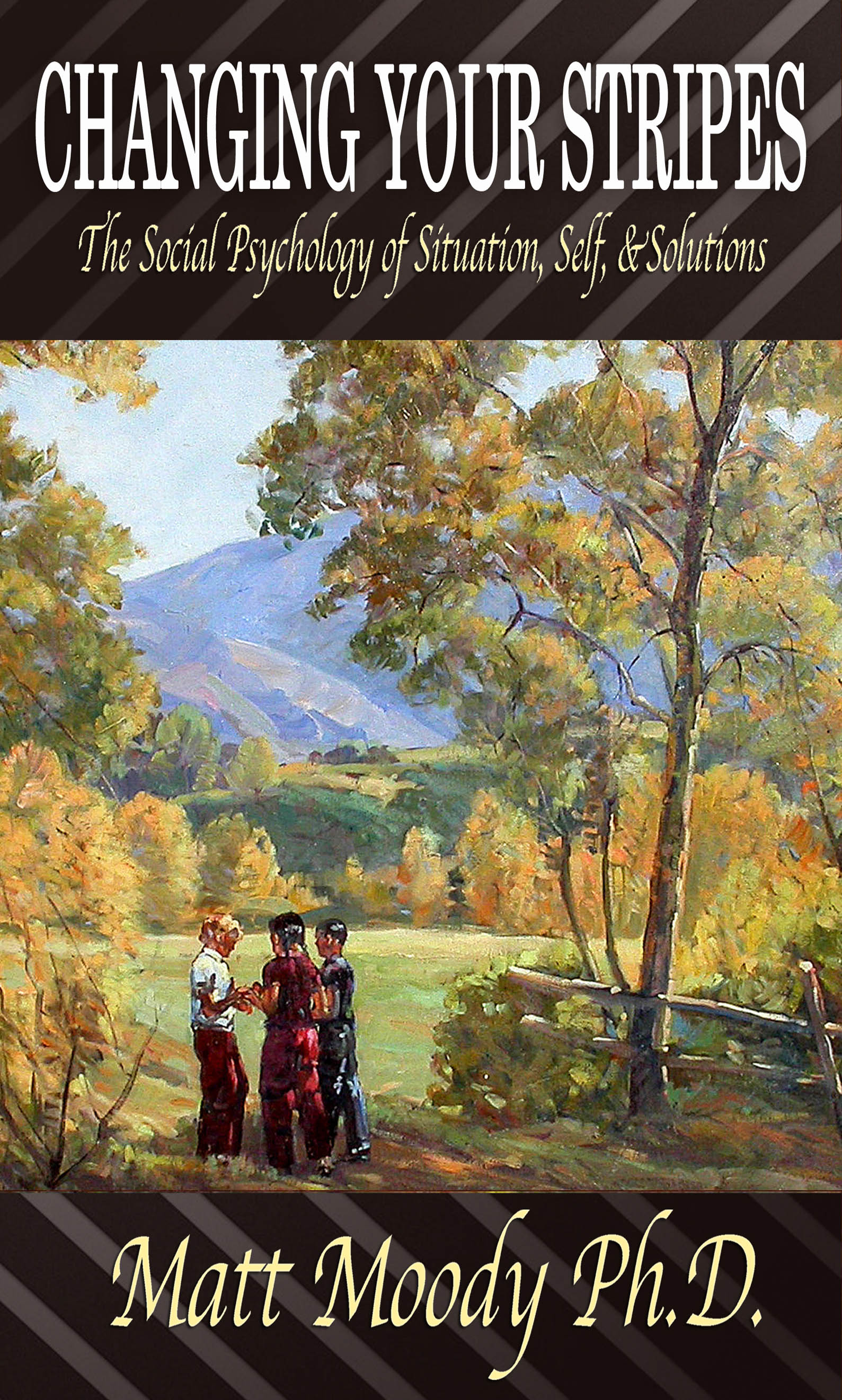
Changing Your Stripes is a
unique reference book that will help
you understand, . . . and solve all of
Life's ever-appearing problems.
Here are more reasons to buy
Changing Your Stripes
Social Psychologist & Personal Advisor
| Home | Ask Dr Matt | Call Dr Matt | Meet Dr Matt | Quotes | Book | Site Index |
.